Why new users didn't come back.
A Y Combinator-backed B2B SaaS for hybrid work. First researcher hired, with no process, no repository and no structured access to users.
- The stakes
- 55% of new users did not come back after their first week.
- What I found
- The problem was not scheduling, it was the lack of a reason to come in.
- The decision
- Redesign around “The Lounge”: connections, events, planning the month.
- The impact
- New-user churn: from 55% to 32%.
Why this study was urgent.
Café, a Y Combinator-backed B2B SaaS for hybrid work, had 20,000 users and was signing up around 300 new ones a week. More than half did not come back after their first week: most of each week of acquisition was lost. As the first researcher hired, I started with no process, no repository and no structured access to users.
- My role
- Lead User Researcher, first hire
- With
- Founders and product team
- Set up
- Recruitment, protocols, continuous feedback, repository
Build the research function from scratch and understand why 55 % of new users didn't come back after their first week.
- 1:1 interviewsQual
HR, office managers and employees: actual hybrid habits versus perceived ones.
- Usability testsTestapic
Moderated and unmoderated tests, written protocols, video and verbatim analysis.
- Continuous feedbackQuant
An ongoing questionnaire and analytics to size the hypotheses from the qual work.
- RepositoryResearch ops
Insights captured in one place, open to the whole product team.
Why this approach
- Build access to users first
With no panel and no process, step one was being able to talk regularly to HR, office managers and employees.
- Alternate qual and continuous feedback
Interviews and tests (Testapic) surface hypotheses; a continuous survey, shown after one week of use, quantifies them over time and supplies targeted contacts for interviews.
- Capture it all in a repository
Dovetail, open to the whole product team: every new question starts from what we already know.
What we needed to know.
- Why don't new users come back after their first week?
- How do teams really decide to come into the office?
- Do managers and employees expect the same thing from the tool?
What users told us.
- 01The problem isn't attendance, it's invisible coordination
Teams don't know why they should come in: when their colleagues will be there, which meetings really need to be in person. The information is scattered across calendars, Slack and gut feeling.
I come in on Tuesdays because I assume my team is there. But I don't really know.
- #1Seeing colleagues is the first reason to come in, and the least supported
The reason mentioned first is not productivity but social connection. Yet nothing makes a shared coffee break or an impromptu lunch any easier.
We bumped into each other at the coffee machine. That's where the real conversations happen.
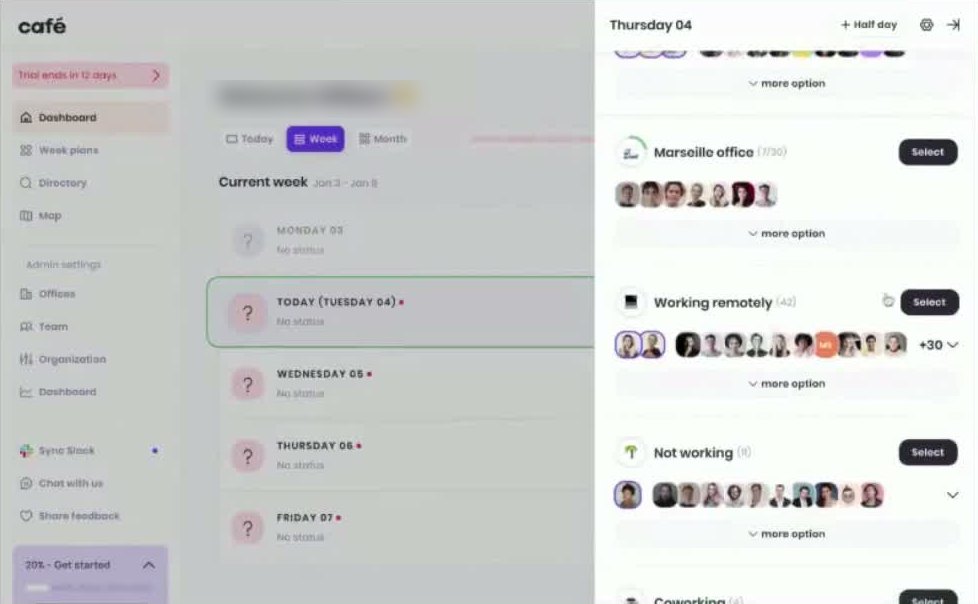
Prototype of the new home, tested in user sessions: see who is in which office before picking your day. User name blurred. - 2Managers and employees follow two opposite logics
Managers want an overall view to organise team moments. Employees want flexibility and to know whether their teammate will be there. One tool, two needs to reconcile.
What to do, in order.
- P1Make visible who is coming, when and why
Give people a reason to come in from day one, rather than just a schedule.
- P1Support the social moments
Connections, events and informal meetups at the heart of the product.
- P2Two views for two logics
An overview for managers, reciprocity and flexibility for employees.
The experience was redesigned around « The Lounge »: connections, events, planning the month in a few clicks. Churn among new users dropped from 55 % to 32 %.
After the redesign around “The Lounge”, new-user churn went from 55% to 32%.
What this study does not tell.
Every method has blind spots. Here are this study's, and how I accounted for them.
- The churn drop follows a full redesign.
It is the result of the whole product team. Research set the direction: a reason to come in before a schedule.
- Two user types with opposite expectations.
Managers and employees were interviewed separately, so as not to merge two needs into one.
He very quickly understood our challenges and constraints, and delivered a user journey that exceeded our expectations. The new solution is now in production and is a real success with users and our business teams.
Understand your users.
Improve what matters.
GuidesHow to find out why your users churnHow many users do you need for a user test?Quant or qual? How to combine surveys and interviews
Cédric de la Chaise · Senior User Researcher · 8 years · Betclic, Roland-Garros · X ↗